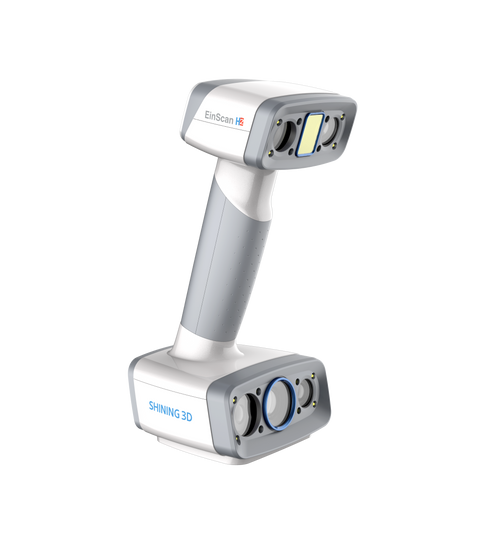
EinScan Rigil Professional Wireless 3D Scanner
The EinScan Rigil is a professional all-in-one 3D scanner built for users who need high-speed capture, detailed geometry, and a flexible workflow without being tied to a workstation. By combining blue laser scanning, infrared scanning, onboard computing, integrated storage, a built-in touchscreen, and replaceable batteries, Rigil allows the complete scanning process to be handled directly from the scanner.
Designed with automotive aftermarket, reverse engineering, product development, custom fabrication, and professional 3D modeling in mind, Rigil provides the freedom to scan where the object is located. Users can work around vehicles, machinery, large assemblies, and individual components without managing a separate computer, power cable, or traditional scanning station.
Three Ways to Work
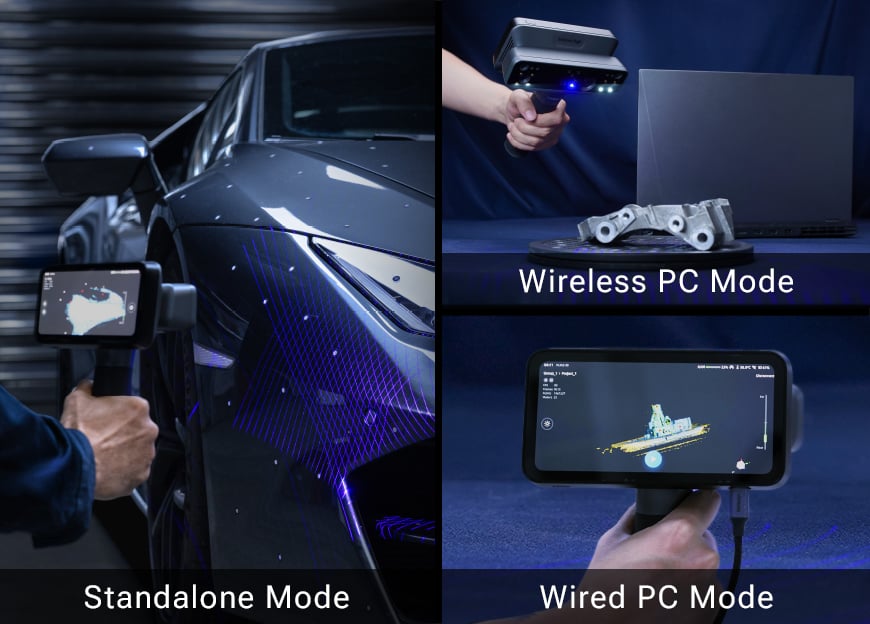
EinScan Rigil supports three operating configurations, allowing the scanning workflow to adapt to the project.
In standalone mode, scanning and data processing are completed directly on the device. The integrated computing hardware, display, storage, and batteries make it possible to capture and review data without connecting the scanner to a computer. Standalone mode supports scanning rates of up to 50 frames per second, providing a portable solution for workshops, garages, job sites, and mobile scanning services.
Wireless PC mode connects Rigil to a computer through its built-in Wi-Fi 6 connection. This gives the operator the mobility of cable-free scanning while using the computer’s processing resources for more demanding projects. In wireless and wired PC modes, scanning performance can reach up to 110 frames per second.
Wired PC mode connects the scanner through USB Type-C, providing a stable connection in environments where wireless networking may be restricted or unreliable. This mode is useful for extended scanning sessions, complex projects, and controlled production environments.
Tri-Mode Scanning for Speed, Detail, and Coverage
Rigil combines three complementary scanning methods in a single system. These modes allow the operator to move between rapid surface capture, detailed feature scanning, and wide-area infrared scanning without switching devices.
The 25 plus 25 crossed blue laser line mode is designed for fast capture of medium and large objects. With a scanning rate of up to 4,800,000 points per second, it can quickly collect broad surface geometry from automotive parts, mechanical assemblies, body panels, molds, sculptures, and industrial components.
For smaller features and difficult areas, the seven parallel blue laser line mode provides more focused scanning. It is suited for edges, openings, deep features, mechanical details, and areas where greater control is needed. Data from the crossed and parallel laser modes can be combined within the same project, allowing users to capture the overall object quickly before concentrating on finer geometry.
IR Rapid mode provides a wider working range for larger objects and general-purpose scanning. With a working distance extending up to 1,500 millimeters, it is useful for vehicle interiors, furniture, people, large components, and objects where broad coverage is more important than the smallest surface detail.
Marker-Free Laser Scanning
One of Rigil’s most useful capabilities is its marker-free laser scanning workflow. Traditional laser scanning often relies on reflective markers to maintain alignment, especially on large or low-feature surfaces. Rigil can use the natural geometry of suitable objects to maintain tracking, reducing preparation time for many projects.
This can be especially valuable in automotive and fabrication environments. Engine components, wheels, brackets, housings, intake parts, trim panels, and mechanical assemblies often contain enough edges, openings, ribs, and surface variation to support feature tracking.
Markers remain useful when scanning smooth, symmetrical, or repetitive geometry, but the ability to begin scanning without covering every object in reference dots makes Rigil faster and more convenient for everyday work.
Designed for Difficult Automotive and Industrial Surfaces
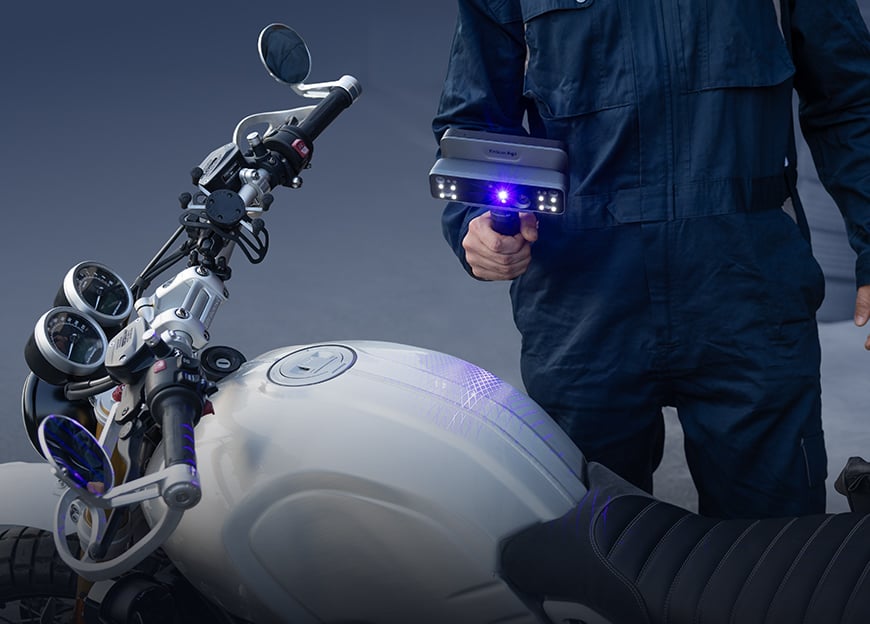
Automotive and industrial parts frequently include black plastics, polished metal, painted surfaces, cast materials, carbon fiber, and reflective finishes. These surfaces can be difficult for conventional structured-light scanners and may require extensive preparation.
Rigil is optimized for challenging materials and environments. Its blue laser scanning modes can capture many dark and reflective surfaces without requiring scanning spray, while scene-adaptive scanning helps the system respond to changes in surface behavior and lighting.
Improved environmental light resistance also makes Rigil more practical outside a controlled studio. It can operate in workshops, near open garage doors, and in outdoor environments where surrounding light would make many scanners difficult to use.
Surface preparation may still improve results on highly reflective, transparent, or optically difficult materials, but Rigil gives users a much stronger starting point for real-world components.
High-Quality Data for Reverse Engineering
EinScan Rigil is capable of volumetric accuracy up to 0.04 plus 0.06 millimeters per meter in Laser HD scanning and resolution down to 0.05 millimeters. This allows it to capture detailed surface geometry for reverse engineering, replacement part development, custom fitment, and CAD reference workflows.
A physical part can be scanned and converted into a digital mesh, which can then be used as the foundation for redesign, surface reconstruction, dimensional reference, or manufacturing. This is useful when original CAD files are unavailable or when a custom component must match an existing vehicle, machine, enclosure, or assembly.
Rigil also supports multi-coordinate alignment, helping scan data fit more naturally into downstream CAD and design processes. Multiple projects can be aligned directly in standalone mode, allowing users to review combined results while still on location.
Advanced Tracking Options
Reliable alignment is essential during handheld scanning. Rigil supports feature tracking, marker tracking, texture tracking, and global marker alignment, allowing the user to choose the method that best matches the object.
Feature tracking is effective on objects with clear geometry and surface variation. Marker tracking provides added stability on smooth or repetitive objects. Texture tracking uses visible surface information to help maintain alignment, while global marker alignment supports more complex projects that require consistent positioning across a larger scan area.
Having several tracking methods available makes Rigil more adaptable than a scanner built around a single workflow. The operator can use the fastest method for the object instead of preparing every project in exactly the same way.
Full-Color Texture Capture
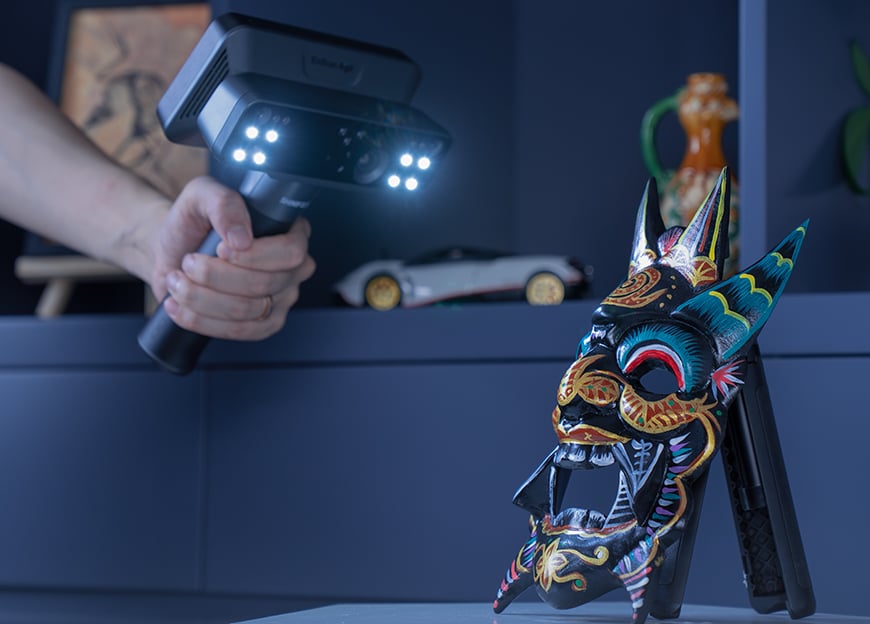
A dedicated 5-megapixel texture camera allows Rigil to capture color information alongside the object’s geometry. Full-color data is useful for visualization, digital archiving, cultural preservation, presentation models, virtual content, and projects where surface appearance is part of the final result.
For higher-quality texture mapping, scan data can also be used with BlueStar Mapping. This workflow can apply photographs captured from a smartphone or DSLR to the scanned model, creating more detailed and realistic color textures.
Users focused primarily on engineering and reverse engineering can work with geometry alone, while visualization and documentation projects can preserve both shape and appearance.
Complete On-Device Processing
Rigil is built around a 6.4-inch 2K AMOLED touchscreen that displays the scanning interface, tracking status, data quality, and captured model. The operator can review the project while scanning rather than returning to a workstation to discover missed areas.
The scanner includes 32GB of LPDDR5 memory, internal system storage, and a 1TB solid-state drive for scan projects. This allows substantial data to be stored and processed directly on the device.
High-efficiency noise reduction helps process larger data sets while maintaining surface quality. Users can generate point clouds, meshes, and completed scan projects through the onboard workflow, making Rigil a complete portable scanning system rather than simply a handheld sensor.
Replaceable Battery System
EinScan Rigil uses two replaceable batteries, allowing it to operate independently from external power during mobile scanning. Batteries can be replaced when depleted, and the scanner also supports USB Type-C power for charging and operation.
This is especially useful when scanning vehicles, machinery, outdoor installations, or objects located away from a convenient workstation. The scanner, display, processor, storage, and power system travel together, reducing the amount of equipment required on site.
Applications
EinScan Rigil is well suited for automotive aftermarket design, classic vehicle restoration, replacement part development, custom fabrication, motorsport, mechanical reverse engineering, product design, digital archiving, 3D printing, and general professional 3D modeling.
Automotive shops can capture engine-bay components, body features, trim, wheels, dashboards, brackets, and custom parts. Fabricators can scan an existing assembly before designing a component that must fit around it. Manufacturers can digitize legacy parts without CAD files, while designers can use the resulting mesh as a reference for new products.
The combination of standalone operation and PC connectivity also makes Rigil useful for scanning service providers. Smaller projects can be completed directly on the device, while larger or more demanding data sets can use the additional power of a connected computer.
A Complete Professional Scanning Workflow
EinScan Rigil brings together the portability of a standalone scanner and the performance of a PC-connected professional system. Its crossed laser lines provide fast surface capture, the parallel laser mode collects detailed features, and IR Rapid mode expands the scanner’s capabilities to larger objects.
For automotive professionals, custom fabricators, designers, and reverse engineering users, Rigil reduces the equipment and preparation normally required for professional 3D scanning. Projects can be scanned, reviewed, processed, and stored directly on the device, while wireless and wired PC modes remain available when additional processing power is needed.
With adaptable tracking, strong material compatibility, full-color capture, and professional scan quality, the EinScan Rigil is a versatile solution for turning physical objects into accurate, design-ready digital models.
Technical Specification
| Work Mode | Wireless Standalone For extra computing resource: PC- Wireless / PC-Wire |
||
| Scan Mode | Laser HD | IR Rapid | |
| Light Source | 25+25 crossed laser lines | 7 blue laser parallel lines | IR VCSEL |
| Resolution | 0.05 ~ 10 mm | 0.2 ~ 10 mm | |
| Scanning Speed | 4,400,000 points/s | 940,000 points/s | 1,600,000 points/s |
| Working Distance | 170 ~ 550 mm | 160 ~ 1500 mm | |
| Alignment Mode | Global Markers / Markers / Features / Hybrid | Global Markers / Markers / Features / Texture / Hybrid | |
| Volumetric Accuracy | Up to 0.04 + 0.06 mm/m | Up to 0.1 + 0.3 mm/m | |
| Camera Resolution | 3D: 2.3MP*2 1.3MP*2; Texture: 5MP | ||
| Output Formats | STL, OBJ, PLY, 3MF, ASC | ||
| Laser Class | Class II | / | |
| Hardware | CPU: 8 core, 2.4GHz; Hard Drive: 1T SSD ROM; 32GB DDR5 RAM; 6.4”2K AMOLED Touch Screen |
||
| Operation Conditions | Temperature -10℃ ~ 40℃ | ||
| Certifications | CE, FCC, ROHS, WEEE, FDA, SRRC, IP50 | ||
| Recommended Configurations for PC | Win10/11, 64 bit; Graphics card: NVIDIA GTX1060; Video memory: ≥6GB; Processor: I7-11800H; Memory: ≥32GB |
||
| Interface & Power Source | USB Type-C Battery: 6000mAh*2; Support 60W-PD3.0 Charger |
||
| Dimension | (H*D*W) 233 × 180 × 72.8 mm | ||
| Net Weight | 870 g (batteries included) | ||