
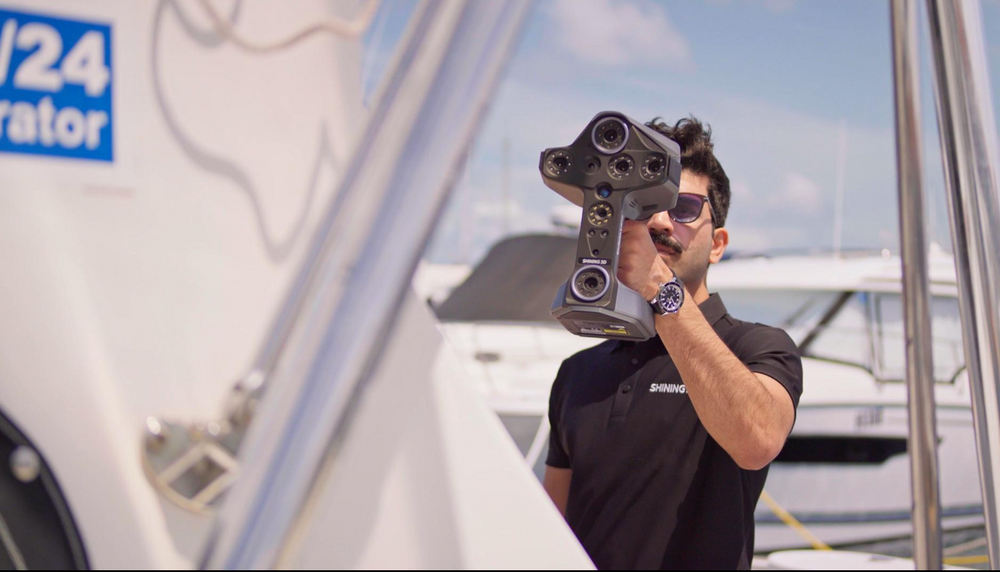
Scanning Large Black/Reflective Surfaces with the EinScan Libre
16th May 2026
Dark and reflective materials have traditionally been some of the most difficult surfaces for handheld 3D scanners to capture accurately. Black coatings absorb projected light, reflective surfaces scatter scanning patterns unpredictably, and repetitive geometry can make maintaining stable tracking even more challenging.
In a recent real-world demonstration, the EinScan Libre was used to scan multiple flights of stairs featuring black reflective railings, dark flooring, and long continuous geometry. All of which is a combination that would typically challenge many portable scanning systems. The test focused on speed, portability, full-color capture, and marker-free scanning using the Libre’s IR Rapid mode.

Why Dark and Reflective Surfaces Are Difficult to Scan
Most structured-light and infrared scanning systems rely on projected patterns being clearly visible to the scanner’s cameras. Dark materials absorb much of that projected light, while reflective surfaces can distort or scatter it. This often leads to incomplete geometry, noisy scan data, tracking instability, and surface holes or missing regions.
These issues become even more noticeable on long continuous objects such as railings, pipes, or stair systems where there may be limited geometric variation to help maintain alignment.
Using IR Rapid Mode for Fast Marker-Free Scanning
For this workflow, the EinScan Libre was configured in IR Rapid mode using hybrid tracking with both feature and texture alignment enabled. This setup prioritized fast capture speed, a large field of view, marker-free operation, and full-color scanning.
The project was also configured with automatic white balance calibration before scanning began, allowing the scanner to optimize color capture for the environment.
Unlike traditional tethered workflows, the Libre handled the entire project directly onboard using its integrated standalone system. This allowed the scan to be completed quickly without external tracking equipment or a connected workstation.

Large-Scale Geometry Without Markers
One of the most impressive aspects of the demonstration was the scanner’s ability to maintain stable tracking across long sections of railing and stair geometry without markers.
Long railings can be particularly difficult for scanners because the geometry becomes visually repetitive. Losing tracking in these situations is common, especially when scanning narrow or reflective structures.
The Libre’s large field of view and extended scanning range helped maintain alignment across these surfaces while allowing the operator to move quickly through the environment. The wider capture area reduced the need for extremely controlled movements and made it easier to maintain continuous tracking during motion.
Capturing Black Reflective Pipes
A major highlight of the scan was the successful capture of a black reflective pipe using IR Rapid mode.
Even though Adaptive IR mode is specifically optimized for difficult reflective materials, the Rapid IR mode was still able to maintain stable tracking and clean geometry with minimal difficulty. This demonstrated how much the Libre’s infrared system and tracking algorithms can compensate for surfaces that would normally require scan spray or extensive preparation on many other scanners.
The ability to quickly capture reflective industrial-style surfaces without markers or extensive setup is particularly valuable in facility documentation, construction scanning, industrial inspection, architectural workflows, and maintenance and retrofit projects.
Full-Color Scanning in Real Time
Throughout the project, the Libre captured full-color texture information alongside geometry data. The scanner’s onboard display allowed real-time monitoring of the scan while maintaining a smooth high-frame-rate workflow during movement.
Because the system processes data directly on-device, missed regions could immediately be revisited and rescanned before final mesh generation. This streamlined workflow is especially important during large environmental scans where returning later to recapture missing data can become time-consuming.

Portable Scanning for Real-World Environments
The demonstration highlights one of the biggest strengths of the EinScan Libre platform: portability without sacrificing capability.
Traditional large-area scanning workflows often require external laptops, marker placement, tethered cables, tripods, or tracking systems.
The Libre’s standalone architecture allows users to move naturally through environments while maintaining professional-level scanning performance in a compact handheld form factor.
For scanning staircases, railings, architectural spaces, and industrial environments, this type of mobility can significantly improve workflow efficiency while reducing setup time.
Conclusion
Scanning dark and reflective surfaces has long been one of the more difficult challenges in handheld 3D scanning. The EinScan Libre demonstration shows how modern infrared scanning systems, combined with large capture ranges and advanced hybrid tracking, can significantly improve reliability in these environments.
By combining marker-free operation, onboard processing, full-color scanning, and stable tracking across difficult geometry, the Libre demonstrates a workflow optimized for fast real-world capture rather than controlled studio-only conditions.