
Our Top 3D Scanner Picks for Automotive Scanning
26th Jul 2026
Automotive 3D scanning covers a wide range of projects. A restoration shop digitizing an entire classic vehicle has very different needs from a fabricator scanning an engine component, a designer capturing an interior, or a quality team inspecting an EV battery enclosure.
That is why there is no single scanner that is best for every automotive application. Object size, required accuracy, surface material, working environment, and final use of the data all play a role in choosing the right system.
SHINING 3D offers several scanners that fit different parts of the automotive workflow. EinScan Rigil provides a flexible all-in-one platform for aftermarket and fabrication work. EinScan Libre offers portable scanning for design, interior capture, and full-color documentation. FreeScan Trak Nova is built for complete vehicles and large-scale professional measurement. FreeScan Omni brings scanning and inspection together for automotive quality control.
This guide explains where each scanner fits and which type of automotive user it is best suited for.
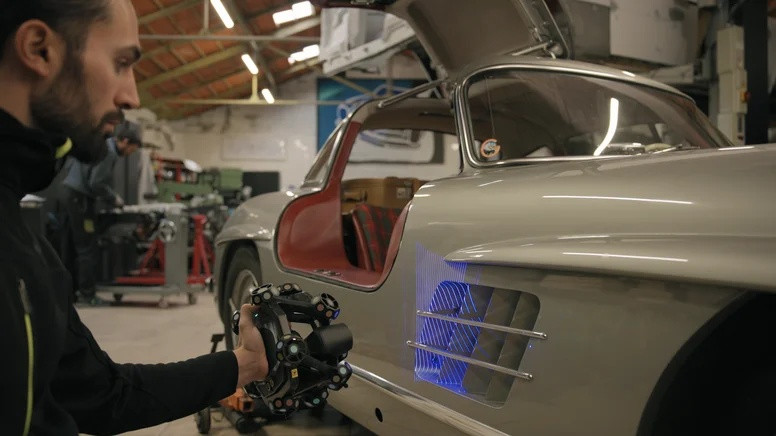
Best for Automotive Aftermarket and Custom Fabrication: EinScan Rigil
EinScan Rigil is a strong choice for automotive aftermarket work, custom fabrication, replacement part development, and general scan-to-design projects. Its all-in-one design combines onboard computing, a built-in display, wireless operation, and multiple scanning modes in a single handheld system.
This makes Rigil especially practical in workshops and garages where users need to move freely around vehicles and components. Instead of setting up a separate computer beside the vehicle, the operator can scan directly with the device and review the data during capture.
Rigil’s laser modes are useful for detailed automotive components such as brackets, intake parts, housings, trim pieces, wheels, engine-bay components, and custom fabricated parts. Its infrared mode provides wider coverage for larger objects and general-purpose scanning, making the system flexible enough to move between individual parts and broader vehicle features.
Marker-free laser scanning can also reduce preparation time on automotive objects that have enough visible geometry. Parts with edges, openings, ribs, engraved details, and irregular shapes may provide enough information for the scanner to track without requiring markers across the entire surface.
For custom shops, restoration businesses, motorsport teams, and aftermarket designers, Rigil offers a useful balance between scanning capability and workflow simplicity. It is well suited for capturing physical parts as references for CAD modeling, checking fitment, creating replacement components, developing accessories, and producing scan-based prototypes.
Best for Automotive Interiors, Full-Color Capture, and General Design Work: EinScan Libre
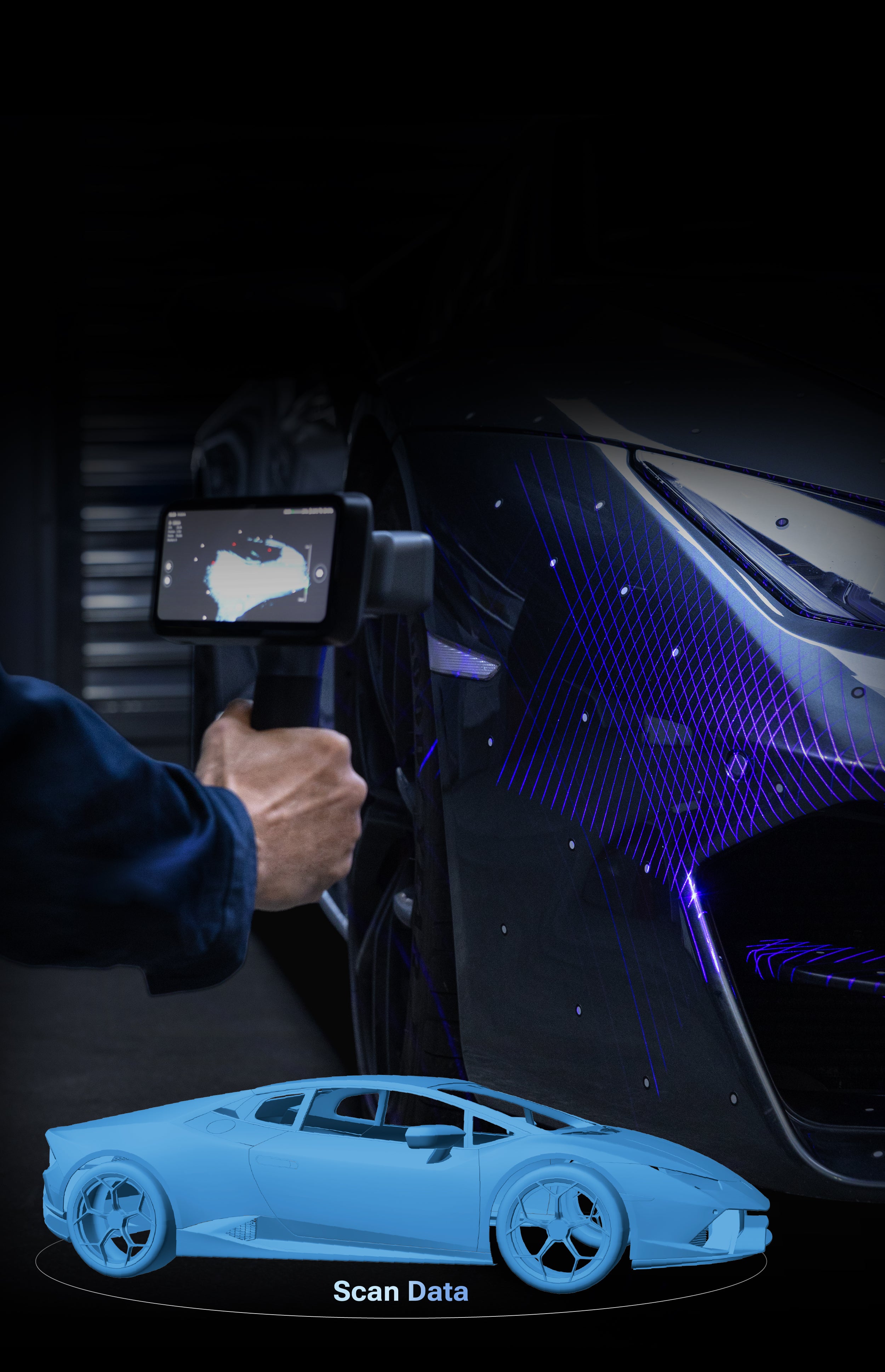
EinScan Libre is a versatile option for automotive users who need wireless standalone scanning, full-color texture capture, and flexibility across different object sizes. It combines blue laser scanning with infrared scanning modes, allowing it to move between detailed components and larger surfaces without requiring a separate scanner.
For automotive interiors, Libre is particularly useful because it can capture both geometry and visual surface information. Dashboards, seats, consoles, door panels, trim, upholstery, controls, and other interior features often include a combination of shape, texture, color, and material variation. Full-color capture helps preserve that appearance alongside the 3D geometry.
This makes Libre a strong tool for interior redesign, accessory development, visualization, digital archiving, restoration documentation, and virtual presentation. A custom interior shop could use scan data to design a replacement console, fit a new panel, create a digital model of an original dashboard, or document a rare interior before restoration begins.
Libre’s infrared modes are also useful for broader vehicle features and medium-to-large objects. These modes provide faster coverage for projects where capturing the overall shape is more important than collecting the smallest possible surface detail. Laser HD mode can then be used when a project requires more focused geometry capture.
Because Libre processes scan data directly on the device, it is well suited for mobile workflows. Users can scan in a garage, showroom, restoration shop, storage facility, or outdoor environment without building a permanent scanning station.
For automotive professionals who need one portable system for color, design, documentation, and general scanning, EinScan Libre offers one of the most flexible workflows in the SHINING 3D lineup.
Best for Complete Vehicles and Large-Scale Restoration: FreeScan Trak Nova
Scanning an entire vehicle is significantly more demanding than scanning an individual component. The scanner must maintain alignment while the operator moves across large body panels, wheel arches, windows, underbody structures, engine compartments, and other areas separated by several meters.
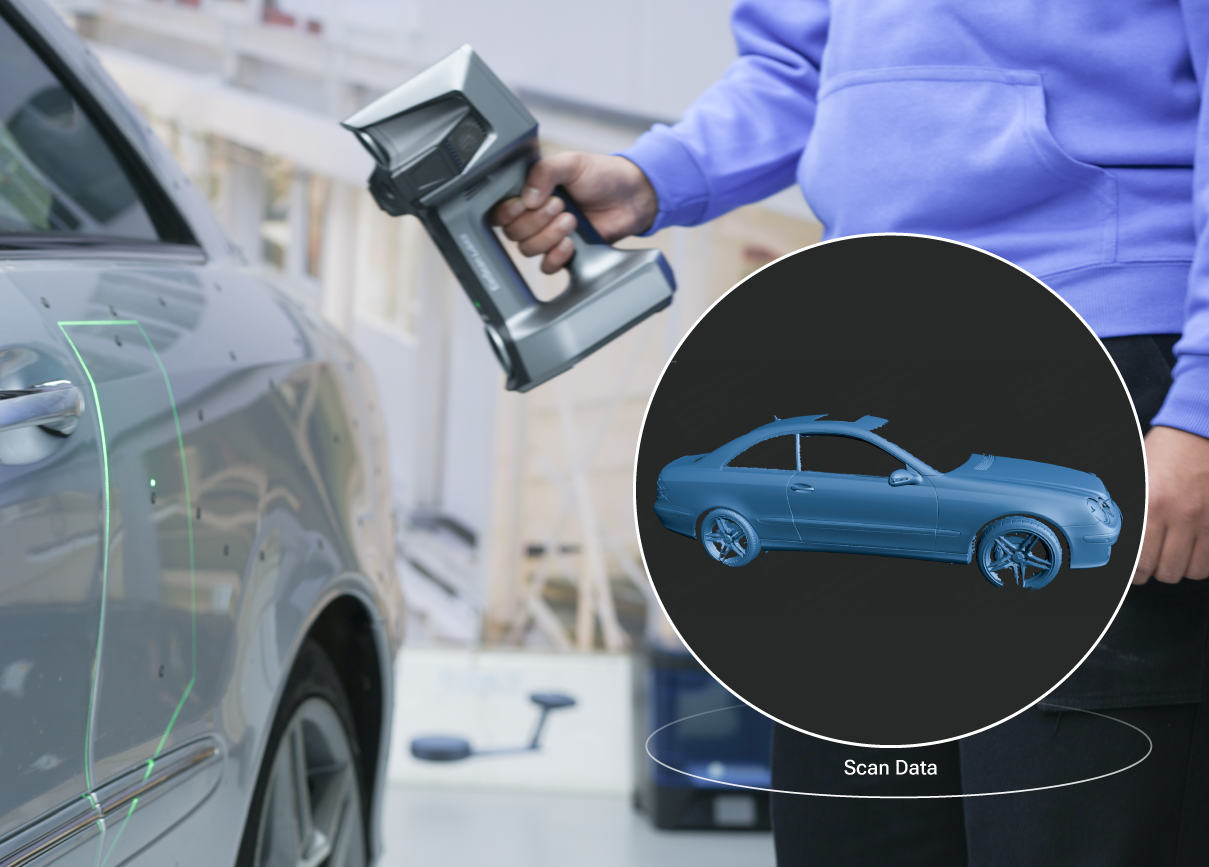
FreeScan Trak Nova is designed for this type of large-scale professional measurement. It combines a wireless handheld scanner with a dynamic optical tracker that follows the scanner’s position in real time.
Because the tracker provides an external reference, the system can maintain stable alignment across a larger measurement volume without depending entirely on the surface geometry of the vehicle. This is especially helpful on complete cars, where broad body panels, repeated shapes, and long scan paths can make standard handheld tracking more difficult.
Trak Nova is an excellent fit for classic-car restoration. A restoration shop can digitize a rare vehicle before disassembly, preserve original body geometry, compare repaired panels, recreate missing components, and build a permanent digital record of the car.
The system can also support motorsport development, aerodynamic modification, body-in-white measurement, tooling, full-vehicle reverse engineering, and fitment analysis for large aftermarket components. Integrated video photogrammetry helps maintain volumetric accuracy across larger scan areas, which becomes increasingly important when the data will be used for professional engineering or dimensional analysis.
The scanner can also be separated from the tracker for other workflows, giving teams additional flexibility when moving between complete vehicles and smaller components.
For companies regularly scanning full vehicles, large body structures, transportation equipment, or major automotive assemblies, FreeScan Trak Nova is the strongest option among these four systems.
Best for Automotive Inspection and Quality Control: FreeScan Omni
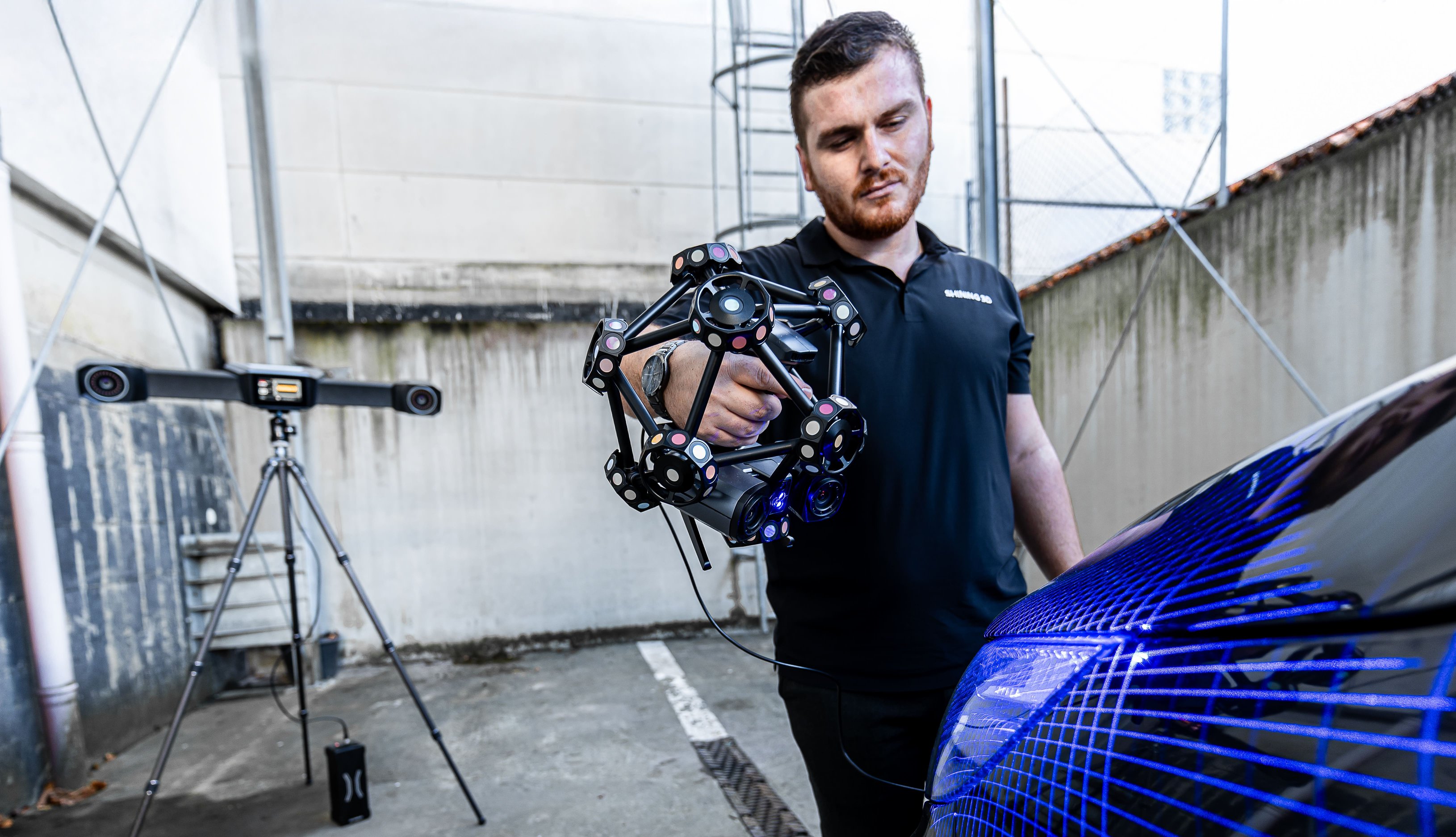
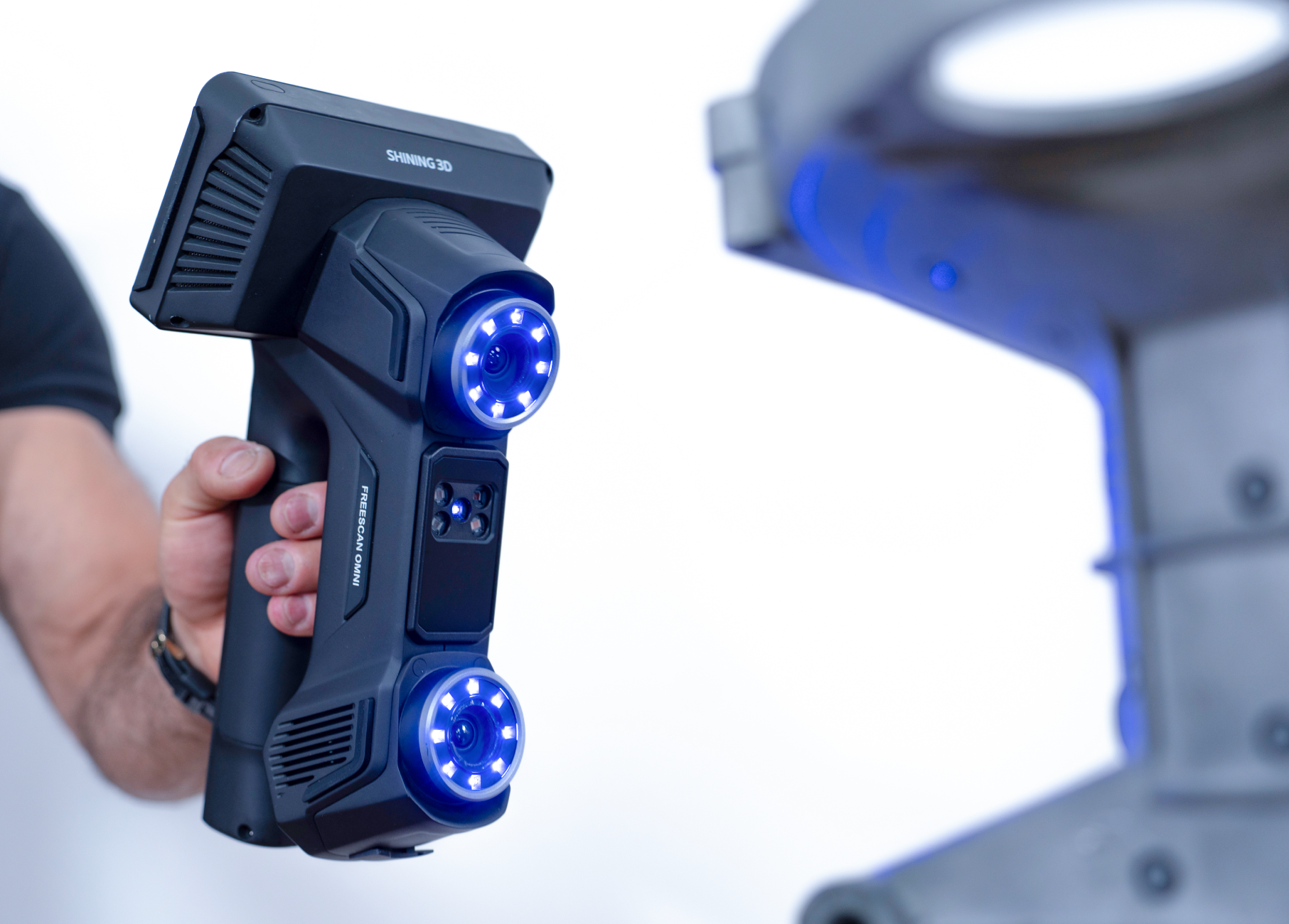
FreeScan Omni is designed for automotive users who need more than geometry capture. It combines wireless metrology scanning, onboard computing, and on-scanner inspection tools in a standalone scan-to-inspect platform.
This makes Omni especially useful for automotive quality control, where teams need to capture a part, compare it against CAD, evaluate deviations, and generate usable inspection results. Instead of treating scanning and inspection as separate workstation-based steps, Omni helps bring those processes together closer to the part.
Automotive manufacturing includes many components that can benefit from full-surface inspection. Battery enclosures, castings, stamped panels, tooling, molded parts, suspension components, machined housings, welded assemblies, and production fixtures may all contain dimensional variation that is difficult to understand through isolated point measurements alone.
By capturing dense surface data, Omni allows users to visualize how the complete part compares to the nominal design. Color deviation maps can reveal warping, high and low areas, assembly problems, tooling wear, and manufacturing variation across the surface.
Its wireless and standalone design is particularly valuable on the production floor. Large or installed components may be difficult to transport to a dedicated inspection room. Omni allows the quality team to bring the measurement system directly to the vehicle, production line, fixture, or component.
The system is also designed to work with difficult automotive surfaces, including dark and reflective materials. Its laser and infrared modes provide flexibility across black plastics, painted panels, metallic components, and mixed-material assemblies.
For automotive manufacturers, EV developers, suppliers, and quality departments that need portable inspection and faster decision-making, FreeScan Omni is the most appropriate choice in this group.
Four Scanners for Four Automotive Workflows
These four scanners are not simply different versions of the same product. Each one addresses a different part of the automotive scanning market.
EinScan Rigil is the practical choice for aftermarket fabrication, scan-to-design work, replacement parts, and shops that want an all-in-one laser and infrared scanner.
EinScan Libre is best suited for automotive interiors, full-color capture, design visualization, restoration documentation, and users who need a flexible standalone scanner for a wide range of vehicle-related projects.
FreeScan Trak Nova is built for complete vehicles, large assemblies, classic-car restoration, and professional large-scale measurement where tracking stability and volumetric accuracy are essential.
FreeScan Omni is designed for automotive inspection, production quality control, EV battery development, tooling validation, and workflows that need scanning, analysis, and reporting closer to the shop floor.
Final Thoughts
The best automotive 3D scanner depends on what part of the vehicle workflow needs to be improved.
A custom fabrication shop may need an approachable system for capturing parts and developing new components. A restoration specialist may need to preserve original color, texture, and interior geometry. A classic-car facility may need to digitize an entire vehicle accurately. A manufacturing quality team may need immediate inspection results on the production floor.
EinScan Rigil, EinScan Libre, FreeScan Trak Nova, and FreeScan Omni each answer one of those needs.
By matching the scanner to the automotive application, users can reduce setup time, capture more useful data, and move more efficiently from the physical vehicle into CAD, inspection, restoration, manufacturing, or digital documentation.