
Best Practices For Dulling and Scanning Sprays
22nd Oct 2026
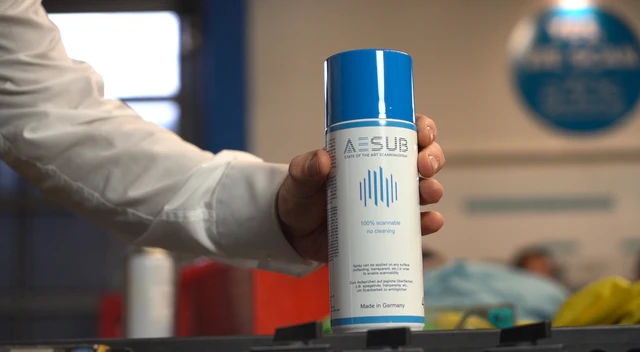
When scanning dark, transparent, or low-contrast objects, or scanning deep holes or sockets in an object, using markers may be impractical or difficult because of the scanned material or the necessary positioning of the markers. For transparent or overly reflective surfaces, such as windows or polished metal, or with sharply curved surfaces without a variety of features, marker stickers may not be visible to the scanner, and texture or feature tracking may not be sufficient. In these situations, dulling or scanning sprays may be used to improve the scan details.
Selecting The Correct Spray For The Scan
Many paint manufacturers offer dulling sprays intended for reducing the shine on photographs and other overly shiny objects. These may be wiped off later without leaving marks. AESUB scanning sprays have the advantage of evaporating off the scanned item over several hours without needing cleanup and without leaving residue. The amount of time an AESUB scanning spray remains on the object depends upon the spray type (see below).
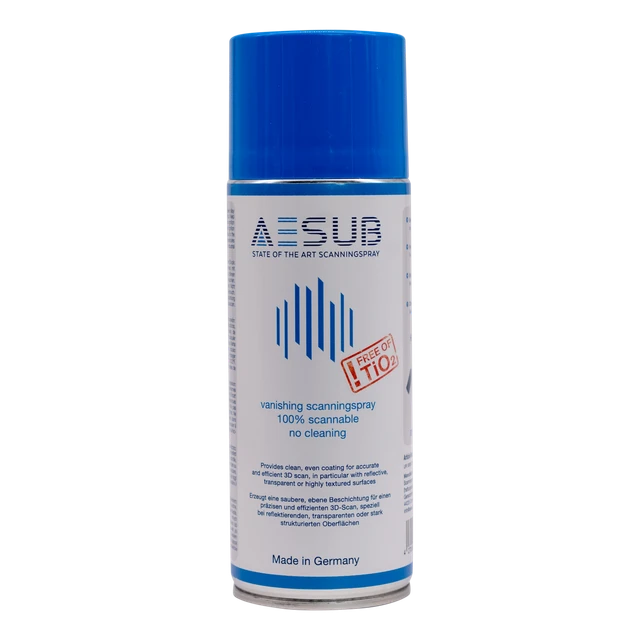
When needing scanning spray, both AESUB Blue and AESUB Orange scanning sprays (https://umax.com/3d-scanning-spray/ ) are suitable for increasing contrast with dark or highly reflective surfaces and improving scans of tight spaces and deep holes and sockets. The main difference between the two is the size of the spray particles and effective scan time.
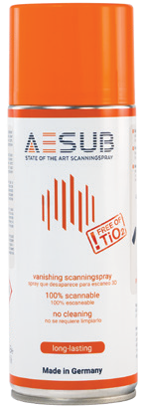
(Please note: the terms "AESUB Blue" and "AESUB Orange" refer to the particular type of spray. Both appear white when sprayed on objects.)
AESUB Blue Scanning Spray:
Evaporates within 4 hours
Effective scan time 1-2 hours
Good for most scans
AESUB Orange Scanning Spray:
Evaporates within 12-24 hours
Effective scan time 4-8 hours
Best for larger areas
Best Practices for Using Scanning Sprays
1. Do Not Apply To People or Other Living Things.
While AESUB scanning sprays are nontoxic, they should never be sprayed on people, animals, or plants. When scanning living things, try increasing the scanner's brightness to bring out detail. In cases of serious issues with contrast, try nontoxic alternatives such as a water mist or a thin powdering of cornstarch to get better resolution of detail. If AESUB scanning spray is accidentally applied to people or animals, remove all contaminated clothing and wash the area with lots of soap and water.
2. Always Follow the Spray's Instructions.
Always follow the instructions and warnings on the can before use. For more specifics on AESUB scanning sprays, refer to the AESUB Safety Data Sheet (SDS). For other dulling sprays, refer to the manufacturer's SDS for the spray in question.
3. Avoid Open Flames or Sparks.
AESUB scanning sprays are nontoxic, but the propellants and solvents in each can are flammable. Avoid using any scanning spray near open flames or sparks, and take care to have proper ventilation while spraying.
4. Wear Eye Protection and Filter Masks When Spraying.
AESUB scanning sprays are nontoxic, but some people may have a reaction to the spray or its propellants. When using, best practices include wearing eye protection, disposable gloves (neoprene or vinyl instead of latex), and a N95 filter mask or better. Always make sure to have proper ventilation when spraying, and avoid breathing in the spraying mist. Remove contact lenses before spraying. As the spray evaporates from the surface, eye protection and filter masks will not be necessary.
5. When Spraying Plastics, Always Spray a Test Area or a Sample First.
AESUB scanning sprays are generally safe for use with most plastics, but the propellants and solvents in other sprays may react with plastics or plastic foams such as Styrofoam. This may include melting, softening, or surface pitting. Every time you use a scanning spray on a plastic or plastic-coated object, test an inobtrusive spot, or a copy made of the same material, with the spray to watch for potential reactions to the surface.
6. Mask Off Any Areas Not To Be Sprayed.
Accidentally spraying areas outside of the intended scan area may affect the quality of the scan. Particularly in close areas, use painter's tape, paper, or cardboard to prevent spray or overspray from spreading past the intended area. Remove these when finished spraying to start your scan.
7. Do Not Overapply.
When spraying an object, try to apply the spray in one even thin coat. When using scanning spray with markers, make sure not to obscure the markers. Try not to apply too much, as this may affect scan accuracy. If you accidentally add too much spray or in the wrong places, wipe it off with a cloth or paper towel and try again.
8. Adjust the Scanner's Brightness
In cases where scans produce too many scanning artifacts, even with scanning spray, consider adjusting the scanner's brightness and try again. When selecting a Scan Target mode, try not to start scanning on Reflective first: try scanning on Normal and only move to Reflective if the scan quality is poor. Also, try adjusting the lighting in the scan area if possible: brighter or more diffused lighting may remove the need for scanning spray.
AESUB Blue Scanning Spray
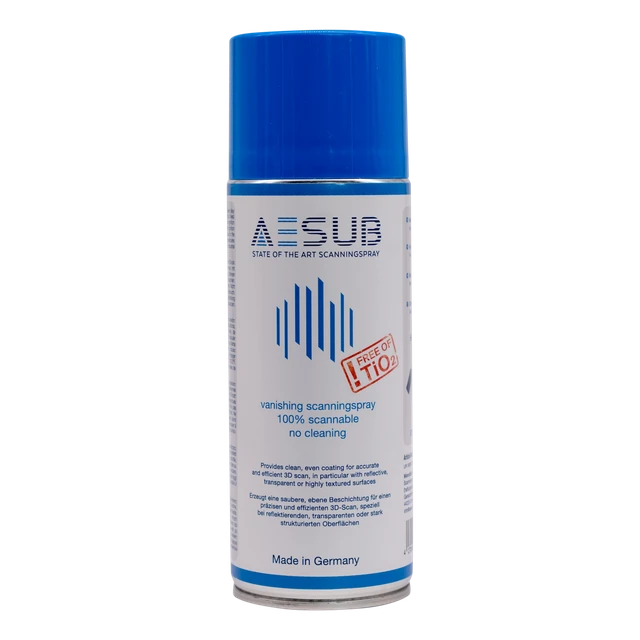
When used correctly, AESUB Blue scanning spray forms a matte, thin, and homogeneous coating on the surface of the object to be scanned. It thus provides the ideal conditions for precise scanner detection. In addition to the active ingredient, AESUB Blue contains a propellant and solvent, all designed for maximum material compatibility. Independent laboratory tests show that AESUB Blue evaporates completely and leaves no residue.